Stop Starting Your Marketing with TikTok or Google: Why Strategy Comes Before the Channel
- News
- August 25, 2026
Marketing strategy advice has become increasingly easy to give.
“Focus on TikTok.”
“Invest more in Google.”
“Work with influencers.”
“Post more content.”
“Run more ads.”
None of these recommendations are inherently wrong.
The problem is that they are often presented as universal answers to problems that are anything but universal.
A strategy that works for a beauty clinic may fail completely for a law firm. A content approach that generates leads for a SaaS company may do very little for a luxury brand. And a channel that creates millions of views may contribute almost nothing to revenue.
The issue is not the platform.
The issue is starting with the platform in the first place.
A strong marketing strategy begins with a much more important question:
What are we trying to achieve, who are we trying to influence, and how does our customer actually make a buying decision?
Only after answering those questions should you start deciding where and how to market.
Marketing Channels Are Not Marketing Strategy
One of the most common mistakes companies make is confusing a channel with a strategy.
TikTok is a channel.
Google is a channel.
LinkedIn is a channel.
Influencers are a tactic or distribution mechanism.
Paid advertising is a tool.
None of these, by themselves, tell you what your business is trying to accomplish.
Imagine a company saying:
“We need to be on TikTok.”
The immediate question should be:
Why?
Is the goal brand awareness?
Demand generation?
Lead generation?
Sales?
Market entry?
Customer retention?
Changing brand perception?
Without knowing the objective, “do TikTok” is not a strategy. It is simply an activity.
And activity without strategic direction can create the illusion of progress without creating meaningful business results.
Why Generic Marketing Advice Fails
The reason generic marketing advice is so common is also the reason it is so dangerous: it sounds simple.
Every industry has its latest “must-have” channel.
One year it is Instagram.
Then TikTok.
Then influencer marketing.
Then short-form video.
Then AI content.
Then whatever platform is receiving the most attention.
But markets do not work according to trends alone.
They work according to customer behavior.
A customer buying a skincare product may discover a brand through social media and make a decision within minutes.
A company hiring a legal advisor may take weeks or months, involve multiple stakeholders, compare several firms, and require a much higher level of trust.
The same marketing channel cannot reasonably be expected to play the same role in both situations.
That is why effective marketing requires context.
Your industry matters.
Your audience matters.
Your offer matters.
Your sales cycle matters.
Your price point matters.
And most importantly, the way customers make decisions matters.
A Marketing Strategy Starts with the Business Objective
Before deciding where to advertise or what content to create, define what marketing is supposed to accomplish.
Are you trying to:
- Build awareness?
- Generate qualified leads?
- Increase sales?
- Enter a new market?
- Improve conversion rates?
- Support the sales team?
- Strengthen brand positioning?
- Increase customer retention?
These are different problems.
And different problems require different strategies.
For example, a relatively unknown company entering a crowded market may need to prioritize awareness, differentiation, and credibility before aggressively pursuing conversions.
Another company might already have strong brand awareness and plenty of website traffic, but struggle to turn that attention into qualified opportunities.
In that case, increasing traffic may be the wrong answer.
The real problem could be positioning, messaging, user experience, or conversion.
This is why marketing objectives should come before marketing tactics.
Know Your Audience Beyond Demographics
Defining your audience by age, location, and gender is only the beginning.
A useful marketing strategy needs to understand how that audience behaves.
What problem are they trying to solve?
What triggers their search?
What questions do they ask before buying?
What objections stop them from moving forward?
Who influences the decision?
How much trust is required?
How many people are involved in the decision?
How long does the buying process take?
These questions are far more useful than simply knowing where your audience spends time online.
Your customers may spend hours on TikTok, for example, but that does not automatically make TikTok the best channel for converting them.
They may discover your company on social media, research you through Google, visit your website, read reviews, talk to a colleague, and eventually speak to sales.
The channel where someone discovers you may not be the channel where they decide to buy.
That distinction is critical.
Visibility Is Not the Same as Business Impact
Modern marketing makes it very easy to measure attention.
Views.
Likes.
Clicks.
Followers.
Reach.
Engagement.
Impressions.
These metrics are useful, but they are not the final destination.
A campaign can generate millions of impressions and still produce poor commercial results.
A LinkedIn post might receive modest engagement but put your company in front of the exact decision-makers you need.
A Google search campaign might produce fewer visitors than a social campaign while generating significantly more qualified leads.
A piece of SEO content might attract fewer visitors than a viral video but reach people who already have strong purchase intent.
The question should therefore not be:
Which channel gets the most attention?
It should be:
Which channel helps us move the right audience toward the business outcome we care about?
That is a much more strategic question.
The Buying Journey Should Influence the Channel
One of the strongest principles in digital marketing strategy is simple:
Choose channels based on how customers buy, not simply where they spend time.
Consider a few different scenarios.
For a highly visual consumer product, social media may play a major role in discovery and inspiration.
For a B2B service, search, thought leadership, referrals, LinkedIn, case studies, and direct sales may work together across a much longer journey.
For a professional service where trust is essential, educational content and credibility signals may be more important than short-term reach.
For a straightforward, low-consideration product, paid search and conversion-focused advertising may play a much larger role.
There is no universal “best marketing channel.”
There is only a channel that is more or less appropriate for a particular strategic objective.
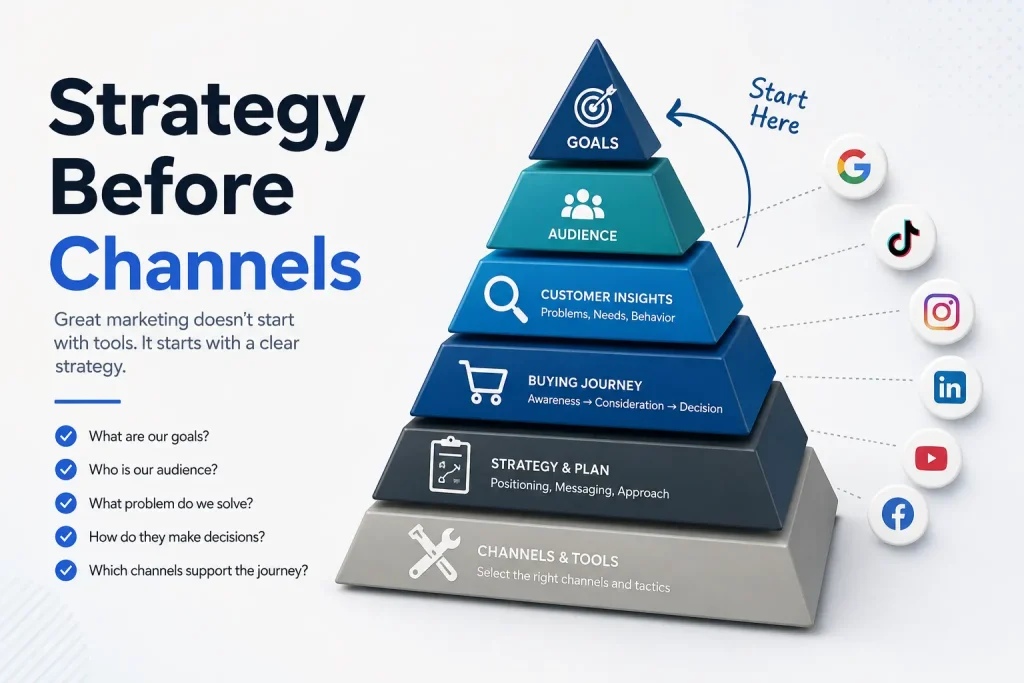
Strategy First. Plan Second. Tools Last.
A useful way to think about marketing is as a sequence:
Business Goals → Audience → Customer Problem → Buying Journey → Strategy → Marketing Plan → Channels → Tactics → Execution → Measurement
The order matters.
When companies start with tools, the strategy often becomes an afterthought.
The platform begins dictating the content.
The algorithm begins dictating the message.
The latest trend begins dictating the budget.
And eventually, the business ends up optimizing marketing activity instead of business outcomes.
But when strategy comes first, the relationship changes.
The channel becomes a means to an end.
Content has a purpose.
Advertising has a role.
SEO supports a defined objective.
Social media contributes to a broader customer journey.
Every marketing activity has a reason for existing.
Stop Asking, “What Is the Best Marketing Channel?”
This question sounds strategic, but it usually is not.
“What is the best marketing channel?”
The answer depends.
The better question is:
What channel is most likely to help us achieve this objective with this audience in this market?
That question forces you to consider the variables that actually matter:
Your business model.
Your audience.
Your positioning.
Your sales cycle.
Your budget.
Your offer.
Your customer journey.
Your competitive environment.
Your internal capabilities.
Your growth stage.
A startup entering a new market may need a completely different channel mix from an established enterprise protecting market share.
Likewise, a consumer brand and a government-focused B2B company should not be expected to follow the same marketing playbook.
A Clear Marketing Strategy Also Protects Your Budget
Strategy is not only about knowing what to do.
It is also about knowing what not to do.
Without a clear strategy, companies often spread their budgets across whatever looks popular at the moment.
More content.
More ads.
More influencers.
More videos.
More platforms.
More campaigns.
Eventually, the marketing team becomes extremely busy while the business sees little meaningful improvement.
This is where strategic thinking creates value.
A strong marketing strategy framework helps prioritize investment according to business impact rather than marketing fashion.
It gives every activity a role.
It makes priorities clearer.
It makes measurement more meaningful.
And it reduces the temptation to chase every new platform or tactic that appears.
How to Build a Marketing Strategy That Actually Guides Execution
Before selecting your channels, work through a few fundamental questions.
What business outcome are we trying to influence?
Be specific. “Increase marketing” is not an objective. Increasing qualified leads by a defined amount, entering a new market, or improving conversion from existing traffic is far more useful.
Who exactly are we trying to reach?
Go beyond demographics. Understand needs, motivations, objections, decision-makers, and buying behavior.
What problem are we solving?
A strong strategy connects the company’s offer with a problem the market actually cares about.
How does the customer make a decision?
Understand where discovery happens, where research happens, where trust is built, and where the final decision is made.
What should the brand be known for?
Your marketing should reinforce a meaningful position, not simply generate activity.
Which channels support that journey?
Only now should you evaluate Google, TikTok, LinkedIn, influencers, email, SEO, paid media, events, partnerships, or other channels.
At this point, channel selection becomes much easier because you are no longer choosing tools randomly.
You are choosing tools to solve a defined problem.
The Best Marketing Strategy Is Not the Most Complicated One
Strategic marketing does not necessarily mean building a massive document filled with complicated frameworks.
A good strategy can often be expressed clearly:
We know what we want to achieve.
We know who we need to influence.
We understand how they make decisions.
We know how we want the market to perceive us.
We know which channels matter most.
We know what each channel is supposed to accomplish.
And we know how success will be measured.
That level of clarity is more valuable than being present on every platform.
Because doing more marketing is not automatically better marketing.
The Real Question Behind Every Channel Recommendation
The next time someone tells you:
“Focus on TikTok.”
“Invest more in Google.”
“Work with influencers.”
“Post every day.”
Ask one question:
“What strategic objective is this helping us achieve?”
That question changes the conversation.
Instead of discussing platforms, you start discussing outcomes.
Instead of discussing trends, you discuss customer behavior.
Instead of copying competitors, you build an approach that makes sense for your own business.
And instead of letting tools shape the strategy, you make the tools serve the strategy.
Final Thoughts
There is nothing inherently wrong with TikTok.
There is nothing inherently wrong with Google.
There is nothing inherently wrong with influencer marketing, paid media, SEO, LinkedIn, or any other marketing channel.
The problem starts when the channel becomes the strategy.
A strong marketing strategy begins before the campaign, before the content calendar, and before the media budget.
It begins with understanding the business, the objective, the audience, the market, and the customer’s buying journey.
Only then should you decide which channels deserve your attention.
Because the smartest marketing question is not:
“Where should we market?”
It is:
“What are we trying to achieve, who are we trying to influence, and what is the most effective way to move them toward a decision?”
Once you answer that, TikTok, Google, influencers, SEO, paid media, and every other tool can finally take their proper place.
Strategy leads. Channels follow.